Invaders and Infidels
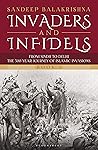 Invaders and Infidels (Book 1): From Sindh to Delhi: The 500-Year Journey of Islamic Invasions by Sandeep Balakrishna
My rating: 5 of 5 stars
Around 6th century AD, after the advent of Islam, there were tectonic shifts in the geopolitical landscape of the world. Within a 100 years, invading Arab armies had marched all the way to North Africa, conquering most of Iran,Iraq,Syria,Damascus,Yamen. They were staring hungrily at Bharatavarsha. For one, they had heard of the immense riches of India. And secondly, it was the "den of infidelity and idolators". The two factors equally spurred the ambition of the blood thirsty Arab invaders. Multiple attempts at trying to make inroads into India was met with stiff resistance and the Arabs realized they were no match for the fabled warriors of Bharatavarsha.
However around 7th century AD, a man who was blessed with an equal measure of cruelty and determination by the name of Hajjaj, rose to the position of the Governor of Iraq under the Caliphate. He was brow beaten twice by the hill folk (Meds) and Jats who lived in the border areas of Sindh. Twice humiliated, the crafty Hajjaj made extensive preparation and made a well planned forray into Sindh with his son in law Muhammed Bin Quasim at the helm. What followed was savagery and butchery that would continue to this day. The crimes inflicted on the Sindhis and the Baluchis in 7th century AD was probably not as clandestine as what the Pakistani army and the ISI are inflicting on the innocent people in Sindh and Baloch.
I would consider this book a landmark historical text that needs to be read by one and all! There are important lessons to be learnt here. For those of us, who grew up on a regular dose of boring Marxist history, with it's liberal mix of fake narratives, concoctions and soul crushing ideas. We are taught that the invaders who came to India literally walked over us with comfortable ease. They claim that our nation deserved such cataclysmic events as the native culture and traditions were rooted in "superstition". The Marxist narrative, like their very foundations is based on untruth and sin.
This book removes all the cobwebs of sickening Marxist narratives, and presents the facts in an easily readable way. The most important myths it shatters are
1. The invaders forayed into Bharatavarsha with relative ease :- While the armies of Islam had conquered most of Asia, North Africa and were marching into Europe by inflicting a crushing defeat on the Visgoths in Spain, the Arabs who tried to enter India faced multiple humiliating defeats
2. The invaders conquered much of North India easily :- After 7th Century AD, for nearly 300 years, the Arabs had only 2 small Kingdoms around Sindh. They were decimated by the Jats,Meds and Rajputs.
3. The Arabs were benevolent not iconoclasts. They allowed worship at some temples:- The Arabs maintained control over Multan, by blackmailing the armies of Bharatavarsha that they would destroy the Idol of Aditya at the famous Sun temple. This was the reason why the Sun temple survived their ravages. They frequently insulted the local populace by hanging beef on top of the idol. Most other temples were destroyed to make way for Mosques. This was a recurring theme, and still is recurring in areas with Muslim majority.
4. Sindh and Afganistan were easily won over :- Jaisimha, the son of Raja Dahir, and the noble Kabul Shahis kept the fire of resistance and fought with everything they had.
5. The invaders were only after the Gold and wealth. They had nothing against the native religion :- When the priests of Somnath temple tried to stop Mohammed of Ghazni, the bloodthirsty son of Sabuktagin from destroying the idol of Somnath by offering immense wealth and riches, the barbarian is said to have replied "Will I be known till eternity as Mahmud the seller of Idols? I will be known till eternity as the iconoclast in the service of the one true faith".
6. Muhammed Ghazni easily decimated Somnath and returned home with the wealth :- The Hindu Kings united and decided to finish of Muhammed of Ghazni. The barbarian ran for his dear life, by taking refuge through the treacherous Makran desert. He eventually made it alive to Ghazni with a fraction of the wealth he plundered and a very small fraction of his army. Most of his army was ravaged by the Hindu kings seeking vengeance. He never dared enter India again and died soon a broken man, never to recover from the ferocity of the Hindu resistance.
This book will show you how the invaders never had it easy. It shows you what immense sacrifices they made to protect the culture, spirituality and traditions. The same culture and tradition of which you are an offspring. Most importantly it also points to the repeated mistakes that were made. Mistakes, that we cannot afford to make. Mistakes which proved too costly. Mistakes that cannot be made anymore. We are surrounded by enemies within and without. We must learn lessons from the true history of India and ensure that our future generations enjoy the same safety, security, comfort and love of Ma Bharati and her rich cultural heritage.
Jai Ma Bharati! Vande Mataram!
View all my reviews


Comments
Post a Comment